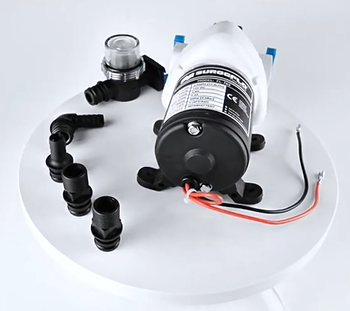
RV Water Pump 12V/24V | 25 PSI 17m Head Fresh Water Pressure Pump
$71.00
12V/24V DC RV fresh water pressure pump with 25 PSI (1.7 bar) pressure and 17m (56ft) head. Self-priming diaphragm pump for RVs, boats, cabins, and off-grid water systems. Quiet operation, built-in pressure switch, easy install. Free shipping worldwide.
Free shipping on orders over $60! Delivery time: 7-12 days
- Satisfaction Guaranteed
- No Hassle Refunds
- Secure Payments
RV Water Pump 12V/24V – 25 PSI 17m Head Fresh Water Pressure Pump
The RV water pump is the heart of your fresh water system, delivering pressurized water from your holding tank to all faucets, showers, and appliances in your RV. This self-priming diaphragm pump provides consistent water pressure at 25 PSI with a 17-meter (56-foot) head, making it suitable for RVs, boats, cabins, tiny homes, and off-grid water systems. The built-in pressure switch automatically turns the pump on when a faucet is opened and off when the faucet is closed, maintaining consistent system pressure without a pressure tank.
Designed for quiet operation and long service life, this pump features a corrosion-resistant housing, self-priming capability (can draw water from up to 6 feet below the pump), and dry-run protection that prevents damage if the water tank runs empty.
Key Features
- Dual Voltage: Works with both 12V DC and 24V DC systems — ideal for RVs, trucks, boats, and solar off-grid systems
- 25 PSI Pressure: 1.7 bar / 25 PSI consistent water pressure for showers, faucets, and appliances
- 17m Head: 56-foot vertical lift capability — suitable for multi-level RVs and elevated water tanks
- Self-Priming: Can draw water from up to 6 feet (1.8m) below the pump — no manual priming needed
- Built-in Pressure Switch: Automatically cycles on/off with faucet use — no pressure tank required
- Dry-Run Protection: Shuts down if the water tank runs empty, preventing pump damage
- Quiet Operation: Rubber mounting feet and internal dampening reduce noise and vibration
- Corrosion Resistant: Marine-grade housing and stainless steel valves for long life
- Easy Installation: Standard 1/2″ NPT ports, simple 2-wire electrical connection
Specifications
| Parameter | Specification |
|---|---|
| Voltage | 12V DC / 24V DC (auto-sensing, dual voltage) |
| Pressure | 25 PSI (1.7 bar / 170 kPa) |
| Max Head | 17m (56 feet vertical lift) |
| Flow Rate | ~10-12 L/min (2.6-3.2 GPM) at open flow |
| Pump Type | 3-chamber positive displacement diaphragm pump |
| Self-Priming | Up to 6ft (1.8m) vertical suction lift |
| Pressure Switch | Built-in, turns on at ~20 PSI, off at ~25 PSI |
| Dry Run Protection | Yes — thermal overload protection |
| Inlet/Outlet | 1/2″ NPT (female) — standard RV water line size |
| Current Draw | ~3-5A at 12V (depending on pressure/flow) |
| Max Current | 8A (startup surge) |
| Operating Temp | 32-140°F (0-60°C) water temperature |
| Ambient Temp | -4°F to 140°F (-20°C to 60°C) |
| Mounting | 4-point rubber foot mounting |
| Dimensions | ~8″ × 4″ × 4″ (200 × 100 × 100mm) |
| Weight | ~3.5 lbs (1.6 kg) |
| Certification | CE, RoHS, ISO 8846 (marine), NSF/ANSI 61 (drinking water) |
Installation Guide
- Choose location: Select a mounting location near the fresh water tank, preferably below the tank level for optimal priming. Ensure the location is dry, well-ventilated, and accessible for maintenance. The pump should be mounted on a flat, rigid surface with the rubber feet facing down to reduce vibration.
- Mount the pump: Use the 4 included mounting screws to secure the pump to the mounting surface. Do not over-tighten — the rubber feet need to flex to absorb vibration. Ensure the pump is level and the inlet/outlet ports are accessible.
- Connect water lines:
- Inlet (suction side): Connect the fresh water tank supply line to the pump inlet (marked “IN” or with an arrow pointing into the pump). Use 1/2″ NPT fittings with Teflon tape. Keep the suction line as short and straight as possible — avoid sharp bends or restrictions. Install a strainer/filter on the inlet side to protect the pump from debris.
- Outlet (pressure side): Connect the water distribution line to the pump outlet (marked “OUT” or with an arrow pointing out). Use 1/2″ NPT fittings with Teflon tape. The outlet line can run to the water heater, faucets, and shower.
- Install a check valve (if not built-in): Install a check valve on the outlet side to prevent water from flowing back into the tank when the pump is off. This maintains system pressure and reduces pump cycling.
- Electrical connection: Connect the pump to a 12V or 24V DC power source. The pump has two wires (red = positive, black = negative). Connect through a dedicated fuse (10A for 12V, 5A for 24V) and an on/off switch inside the RV. Ensure proper wire gauge (minimum 14 AWG for runs under 10ft, 12 AWG for longer runs). Polarity matters for some pump models — if the pump runs but doesn’t pump water, reverse the wires.
- Prime the pump: Before first use, fill the fresh water tank. Open a faucet to allow air to escape. Turn on the pump power switch. The pump will start and begin priming. It may take 30-60 seconds for water to reach the faucet as air is purged from the lines. Once water flows steadily from the faucet, close it — the pump should build pressure and shut off automatically.
- Test for leaks: With the system pressurized (pump off but pressure maintained), inspect all water connections for leaks. Pay special attention to the inlet and outlet fittings. Tighten any leaking connections. Check the pump body and fittings after the pump has cycled on and off several times.
- Verify operation: Open and close faucets to verify the pump cycles on and off correctly. The pump should start immediately when a faucet is opened and shut off within 2-3 seconds of closing. Check water pressure at all fixtures — it should be consistent and strong. Listen for unusual noises (grinding, rattling) that may indicate a problem.
- Winterize: Before storing the RV in freezing temperatures, drain all water from the system and pump. Either use RV antifreeze to fill the lines or blow out the lines with compressed air. Remove the pump or ensure it is completely drained to prevent freezing damage.
Common Applications
- RVs & Campers: Fresh water system for travel trailers, fifth wheels, motorhomes, and pop-up campers
- Boats & Marine: Fresh water pressure for liveaboard boats, yachts, and sailboats (marine-grade construction)
- Cabins & Tiny Homes: Off-grid water pressure for cabins, tiny homes, and remote structures without municipal water
- Agricultural Use: Livestock watering, greenhouse irrigation, and equipment cleaning
- Food Trucks & Concessions: Compact water pressure for hand washing and cleaning in mobile food service
- Emergency Backup: Reliable water pressure during power outages when paired with a battery bank or solar system
- Sprayer & Transfer: Can be used for water transfer, lawn spraying, and general fluid transfer (non-corrosive liquids)
Maintenance Tips
- Clean the inlet strainer: The inlet strainer/filter should be cleaned every 1-3 months (more often if using water from lakes, rivers, or wells). Remove the strainer cap, rinse the mesh screen, and reinstall. A clogged strainer reduces flow and can damage the pump.
- Check for leaks: Inspect all water connections monthly for leaks. Even a small leak can cause the pump to cycle frequently, reducing its lifespan and draining your battery.
- Sanitize the system: Sanitize the fresh water tank and lines at least once per season (or every 3-6 months with regular use). Use a household bleach solution (1/4 cup bleach per 15 gallons of water) or a commercial RV water sanitizer. Let it sit for 4-12 hours, then flush thoroughly.
- Inspect wiring: Check the electrical connections annually for corrosion, looseness, or fraying. Tighten or replace as needed. Ensure the fuse is the correct amperage.
- Lubricate: This pump is permanently lubricated and requires no additional lubrication under normal use. Do not attempt to oil or grease the pump — this can damage the internal components.
- Replace every 5-7 years: Under normal RV use, a water pump typically lasts 5-7 years. If you notice declining pressure, increased noise, frequent cycling, or leaks, it may be time for replacement. Keeping a spare pump on hand ensures you won’t be without water if it fails during a trip.
Troubleshooting Guide
| Symptom | Possible Cause | Solution |
|---|---|---|
| Pump doesn’t run at all | No power, blown fuse, bad switch, broken wire | Check 12V/24V power at pump terminals. Replace fuse. Check switch and wiring. |
| Pump runs but no water | Empty tank, clogged strainer, air leak in suction line, pump not primed | Fill tank. Clean strainer. Check suction line for leaks. Prime pump manually. |
| Pump runs continuously | Open faucet, leak in system, faulty pressure switch, stuck check valve | Close all faucets. Check for leaks. Replace pressure switch. Check/replace check valve. |
| Weak water pressure | Clogged strainer, kinked line, restricted faucet aerator, worn pump diaphragms | Clean strainer. Check lines for kinks. Clean faucet aerators. Replace pump if diaphragms are worn. |
| Pump cycles on/off frequently | Small leak, faulty pressure switch, no accumulator tank, check valve leaking | Check for leaks. Replace pressure switch. Install accumulator tank. Replace check valve. |
| Loud or noisy operation | Loose mounting, hard plumbing (no flex lines), cavitation (air in system), worn bearings | Tighten mounts. Install flexible hose connections. Bleed air from system. Replace pump if bearings are worn. |
| Pump blows fuse | Short circuit, seized pump motor, excessive current draw | Check wiring for shorts. Test pump motor resistance. Replace pump if seized or drawing excessive current. |
Frequently Asked Questions
Q: What’s the difference between 12V and 24V pumps?
A: The main difference is the electrical system voltage. 12V is the standard for most RVs, cars, and small boats. 24V is common in larger trucks, buses, some boats, and solar off-grid systems. This pump is dual-voltage, meaning it automatically works with either 12V or 24V systems — no configuration needed. At 24V, the pump draws half the current (amperage) for the same power output, which means smaller wires and less voltage drop over long runs. At 12V, the pump draws more current but is compatible with the vast majority of RV electrical systems. Both voltages provide the same water pressure and flow rate.
Q: Do I need a pressure tank (accumulator) with this pump?
A: No, this pump has a built-in pressure switch that automatically cycles on and off as needed, so a pressure tank is not required. However, installing an accumulator tank (1-2 gallon pre-charged pressure tank) can provide several benefits: (1) Reduces pump cycling — the tank stores pressurized water so the pump doesn’t turn on for every small water use (like getting a glass of water), (2) Smoother water pressure — reduces pressure fluctuations when multiple fixtures are used, (3) Longer pump life — less cycling means less wear on the pump motor and switch, (4) Quieter operation — the pump runs less frequently. If you’re using the pump for full-time living or high-demand applications, we recommend adding an accumulator tank. For occasional RV use, the built-in pressure switch is sufficient.
Q: Can this pump be used for saltwater or other liquids?
A: This pump is designed for fresh water (potable water) use only. It is NOT suitable for saltwater, seawater, fuel, chemicals, or corrosive liquids. Using it with non-potable liquids can damage the internal components (diaphragms, valves, seals) and void the warranty. For saltwater or marine washdown applications, you need a pump specifically designed for saltwater use with corrosion-resistant materials (bronze or stainless steel body, Viton seals). For fuel or chemical transfer, use a pump designed for those specific fluids.
Q: How do I winterize the pump?
A: To winterize the pump and water system for freezing temperatures: (1) Turn off the pump power and disconnect from the battery. (2) Drain the fresh water tank completely. (3) Open all faucets (hot and cold) to drain the lines. (4) Either: (a) Blow out the lines with compressed air (30-40 PSI) until no more water comes out, OR (b) Fill the system with RV-specific antifreeze (non-toxic, propylene glycol-based) by pouring it into the fresh water tank and running the pump until antifreeze comes out of all faucets. (5) If using the blow-out method, remove the pump or ensure it is completely drained. You can also disconnect the inlet and outlet lines and briefly run the pump to expel any remaining water. (6) Leave the faucets slightly open during storage to allow for expansion if any residual water freezes. NEVER use automotive antifreeze (ethylene glycol) in a potable water system — it is toxic!
Related Products
- 385314349 Toilet Water Valve — RV toilet water valve assembly for Dometic & Sealand toilets
- 92089 Water Heater Valve Kit — 10-gallon RV water heater valve kit
- Parallax 45RU Converter/Charger — 45A RV power converter and battery charger
Need help choosing the right water pump for your RV or off-grid system? Contact our technical team with your requirements. Free shipping and duties included on all orders.
You must be logged in to post a review.


Reviews
There are no reviews yet.